
learning
•
Apr 02, 2026
Back to resources
Managing Your Farm Money, Season by Season
A simple, practical guide to help you track your farm income and expenses, plan ahead before you plant, and stay financially stable even when seasons are unpredictable.
Why Financial Discipline Matters
Farming operates in a constrained and often unpredictable environment. Weather variability, input price fluctuations, and inconsistent market access all introduce risk.
In this context, financial discipline becomes the control layer that determines whether a farm survives beyond a single season.
In this context, financial discipline becomes the control layer that determines whether a farm survives beyond a single season.
Many farms appear productive on the surface but struggle financially because there is no clear visibility into performance. Harvest volumes may be high, but without structured tracking and planning, it is difficult to determine whether that output translates into actual profit.
“What you do not track, you cannot control. What you cannot control, you cannot improve.”
This playbook focuses on building a repeatable finance rhythm that supports both daily decisions and long-term planning.
Start With the Basics: Know Your Money Flow
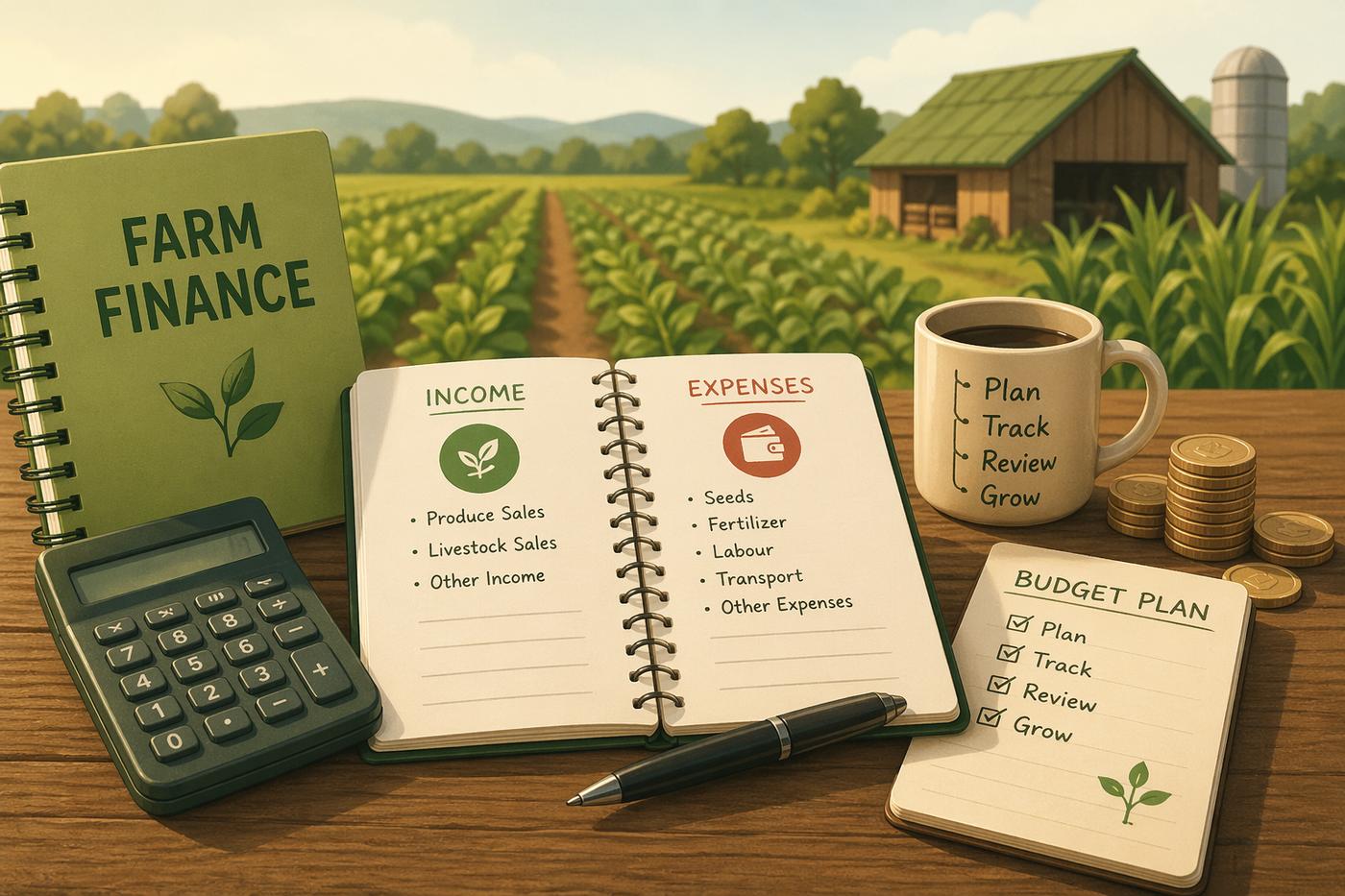
The foundation of farm finance is understanding how money moves through your operation.
Separate all inflows from outflows. Income should include all revenue streams, not just primary crop sales.
Expenses should capture everything required to produce, move, and sell that output.
Expenses should capture everything required to produce, move, and sell that output.
To keep this practical, focus on three core actions:
- Record every income source consistently
- Capture all expenses, including small and irregular ones
- Review records weekly to identify patterns
The key here is completeness. Partial tracking creates misleading conclusions. When this system is maintained properly, patterns begin to emerge and inefficiencies become visible.
Understand What Profit Actually Means
Profit is frequently misunderstood in farming contexts. It is common to equate high sales with success, but revenue alone does not indicate financial health.
Profit = Total Revenue − Total Costs
Costs must include both:
- Direct costs: seeds, fertilizers, pesticides, labour
- Indirect costs: transport, storage, equipment wear, operational overhead
A critical step is assigning costs at the crop or enterprise level. Without this, it becomes difficult to evaluate which activities are performing well.
One crop can quietly absorb losses while another carries the farm.
When profit is measured correctly, decisions become clearer and more defensible.
Build a Seasonal Budget Before You Plant
A budget is a forward-looking control mechanism. It defines how resources will be allocated before they are spent.
Before planting begins, outline expected costs across the entire crop cycle. At the same time, project expected revenue based on realistic yields and current market conditions.
A practical budgeting structure should include:
- Expected input costs
- Labour requirements
- Operational and logistics costs
- A risk buffer for uncertainty
Avoid optimistic assumptions. Conservative estimates create stability.
“A budget is not a prediction. It is a boundary for decision-making.”
Plan Costs by Crop Cycle Stages
Breaking costs into stages improves both clarity and execution. Each phase of the crop cycle has distinct financial requirements.
A simple structure to follow:
- Land preparation
- Planting
- Crop care
- Harvest
- Post-harvest handling
- Market delivery
This approach aligns financial planning with actual farm operations. It ensures that cash is available when needed and reduces disruptions caused by poor timing.
It also improves analysis. If costs increase unexpectedly, you can isolate the exact stage responsible.
Track Daily Expenses Without Exception
Consistency in tracking is more important than the tools used.
Every expense, regardless of size, should be recorded. Small costs are often ignored, but they accumulate and significantly impact margins.
Focus on these habits:
- Record expenses on the same day they occur
- Avoid relying on memory
- Keep entries simple and consistent
Discipline at this level prevents small leaks from becoming large losses.
Use a Simple Ledger System
You do not need complex tools to achieve financial clarity.
A basic ledger structure is sufficient as long as it is used consistently. Each entry should include:
- Date
- Category
- Amount
- Purpose
Categories should remain consistent over time. This allows for aggregation and meaningful comparison.
The value of the ledger is unlocked during review. Without review, even accurate records remain underutilized.
Build a Weekly and Monthly Finance Rhythm
Financial management in farming is not a one-time activity. It is a continuous process that requires structured review.
A simple operating rhythm:
Weekly
- Review all recorded expenses
- Compare actual spending against budget
- Identify avoidable or unusual costs
Monthly
- Reassess the budget
- Adjust projections based on real data
- Reallocate resources where necessary
This rhythm introduces control into a variable system and ensures decisions are based on current data.
Strengthen Decision-Making Over Time
As records accumulate across multiple seasons, they become a strategic asset.
Historical data allows you to:
- Compare crop performance across seasons
- Identify recurring cost patterns
- Improve accuracy in budgeting
Over time, estimation is replaced by evidence.
This transition is what separates reactive farming from structured farm management.
Build Resilience Into the System
Resilience is the ability to absorb shocks without disrupting operations.
Financial discipline contributes directly to resilience by enabling:
- Better cash flow management
- Controlled spending
- Allocation of emergency reserves
A resilient farm is not one that avoids risk. It is one that is prepared for it.
“Stability in farming is not about control of conditions, but control of response.”
Treat Finance as an Operational System
Farm finance should not be treated as an administrative task. It is part of the core operating system of the farm.
At a high level, the system functions as a loop:
- Track financial activity
- Plan based on available data
- Execute within defined limits
- Review and adjust
When this loop is maintained, the farm becomes more predictable, more efficient, and more resilient.
This is not about complexity. It is about applying structure, consistency, and discipline over time.