
Quick stats
| Family | Solanaceae |
|---|---|
| Typical harvest | 18.3 t/ha |
| Varieties | 3 |
| Pests & diseases | 9 |
| Seasons | 4 |
Crop profile
| Growth habit | tree |
|---|---|
| Days to harvest | perennial |
| Main uses | Fresh fruit; processing (juice, sauces); agroforestry/home gardens |
| Pollination | self |
| Origin / where it grows | Andean origin; grown in cool subtropics and highland tropics |
Weather, soil & spacing
| Best temperature | 14–22 °C |
|---|---|
| Rainfall | 900–1400 mm/yr |
| Altitude | 800–2600 m |
| Best pH | 6–6.8 |
| Soil type | Deep, fertile, well-drained loam; high organic matter |
| Row spacing | 300 cm |
| Plant spacing | 300 cm |
| Seed rate | kg/ha (check local recommendation) |
| Nursery days | 90 |
Simple notes for farmers
About the crop: This crop has a growth habit described as "tree". You can normally start harvesting about perennial days after planting, depending on care and variety.
Main use: Farmers mostly grow this crop for fresh fruit; processing (juice, sauces); agroforestry/home gardens.
Pollination: This crop is mainly pollinated by self. Keeping flowers healthy and having insects like bees in the field helps improve fruit set and yields.
Where it grows: Andean origin; grown in cool subtropics and highland tropics It is grouped under: Fruits & Nuts.
Best climate: This crop does well in warm areas where the temperature is usually between 14 and 22 degrees Celsius. It prefers places that receive around 900 to 1400 millimetres of rain in a year. It can grow from near sea level up to about 2600 metres above sea level.
Soil: The crop grows best in slightly acidic to near neutral soils, with a pH of about 6 to 6.8. It does well in deep, fertile, well-drained loam; high organic matter. Good drainage is important, so avoid waterlogged spots.
Plant spacing: Plant in rows about 300 centimetres apart, and leave about 300 centimetres between plants in the row. This gives each plant enough space for roots and canopy to spread.
Seed or planting material: Use good quality seed or healthy planting material. Follow local extension advice for the exact amount per hectare.
Nursery period: If you raise seedlings in a nursery, keep them there for about 90 days before transplanting to the main field, when they are strong and healthy.
Farmer guide (mwongozo wa mkulima)
Nutrient schedule (mbolea kwa hatua)
| # | Stage | DAP | Product | Rate | Targets (kg/ha) | Notes |
|---|---|---|---|---|---|---|
| 1 | Basal at planting | 0 | Compost + DAP 18-46-0 (light) | 5 kg/plant (compost) + 100 g DAP | N: —, P₂O₅: 10, K₂O: — | Mix into backfill; keep away from stem |
| 2 | Vegetative split N | 90 | CAN 26% N | 150 g/plant | N: 10, P₂O₅: —, K₂O: — | Apply in ring under canopy; water in |
| 3 | Pre-bloom balanced feed | 270 | NPK 17-17-17 | 200 g/plant | N: 10, P₂O₅: 10, K₂O: 10 | Light dose before flowering |
| 4 | Fruit fill K boost | 330 | Sulfate of potash (SOP) | 200 g/plant | N: —, P₂O₅: —, K₂O: 15 | Prefer SOP for fruit quality |
| 5 | Micronutrient foliar (opt.) | 300 | Ca/B/Zn foliar (as label) | 0 — | N: —, P₂O₅: —, K₂O: — | Apply in cool hours to support set/skin |
Nutrient requirements
| Nutrient | Stage | Amount | Unit |
|---|---|---|---|
| N | Basal | 50 | kg/ha |
| P₂O₅ | Basal | 30 | kg/ha |
| K₂O | Basal | 60 | kg/ha |
| N | Topdress | 40 | kg/ha |
| N | Establishment | 20 | kg/ha |
| P₂O₅ | Establishment | 20 | kg/ha |
| K₂O | Establishment | 20 | kg/ha |
| N | Vegetative | 40 | kg/ha |
| K₂O | Vegetative | 30 | kg/ha |
| N | Flower_set | 15 | kg/ha |
| P₂O₅ | Flower_set | 20 | kg/ha |
| K₂O | Flower_set | 30 | kg/ha |
| N | Fruit_fill | 10 | kg/ha |
| K₂O | Fruit_fill | 40 | kg/ha |
| N | Maintenance | 30 | kg/ha |
| P₂O₅ | Maintenance | 10 | kg/ha |
| K₂O | Maintenance | 30 | kg/ha |
Field images (picha shambani)
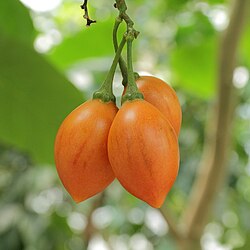
| Name | Country | Maturity | Traits |
|---|---|---|---|
| Red Tamarillo | KE | 420 | Juice color; market preferred |
| Red tamarillo (local) | KE | 360 | Deep red fruit; good processing |
| Golden/yellow selection | UG | 360 | Yellow fruit; mild flavor |
| Stage | Product | Rate (kg/ha) | Notes |
|---|---|---|---|
| Basal | Compost (well-decomposed) | 4000 | Mulch rings/basins |
| Vegetative | CAN 26% N | 70 | Split 2–3× per year on young plants |
| Fruit fill | Sulfate of potash (SOP) | 60 | Boost K for fruit quality |
| Name | Type | Symptoms | Management |
|---|---|---|---|
| Late blight | disease | Leaf/stem blight | Protectants; airflow |
| Aphids | pest | Leaf curl; honeydew; sooty mold; virus risk | Conserve predators; control ants; selective insecticides if needed |
| Whiteflies | pest | Leaf yellowing; honeydew; virus vector | Yellow traps; natural enemies; targeted controls |
| Red spider mites | pest | Stippling/bronzing in dry spells | Maintain humidity; miticides if severe |
| Fruit flies (Tephritidae) | pest | Stings; larval tunnels; fruit drop | Field sanitation; baiting; fruit bagging; timely harvest |
| Powdery mildew | disease | White powder on leaves/shoots | Open canopy; resistant selections; fungicides if persistent |
| Bacterial wilt (Ralstonia) | disease | Sudden wilting; brown vascular tissue | Avoid infested fields; rotate; hygiene; grafting on tolerant rootstocks where used |
| Anthracnose/fruit rots | disease | Sunken lesions; postharvest decay | Pruning for airflow; sanitation; careful handling; protectants in wet weather |
| Root-knot nematodes | pest | Root galls; stunting | Organic matter; solarization/cover crops; tolerant rootstocks if available |
| System | Typical | Min | Max | Notes |
|---|---|---|---|---|
| highland orchard | 15 | 8 | 25 | |
| smallholder rainfed | 15 | 8 | 25 | 10–25 kg/tree typical under moderate management |
| irrigated/intensive | 25 | 15 | 40 | Good cultivars, pruning, and nutrition |
| Country | Region | Planting | Harvest |
|---|---|---|---|
| KE | Highlands | Mar–May / Oct–Nov | Multiple flushes/year |
| KE | Highlands (long rains) | Mar–Apr | Oct–Feb |
| KE | Highlands (short rains) | Oct–Nov | May–Sep |
| UG | Southwest highlands | Mar–Apr | Oct–Feb |
| Country | Region | Suitability |
|---|---|---|
| KE | Frost-prone uplands | Low |
| KE | Highlands | High |
| KE | Highlands & cool mid-altitudes | High |
| KE | Hot lowlands (>28 °C mean) | Low |
| TZ | Northern highlands | High |
| UG | Southwest highlands | High |