
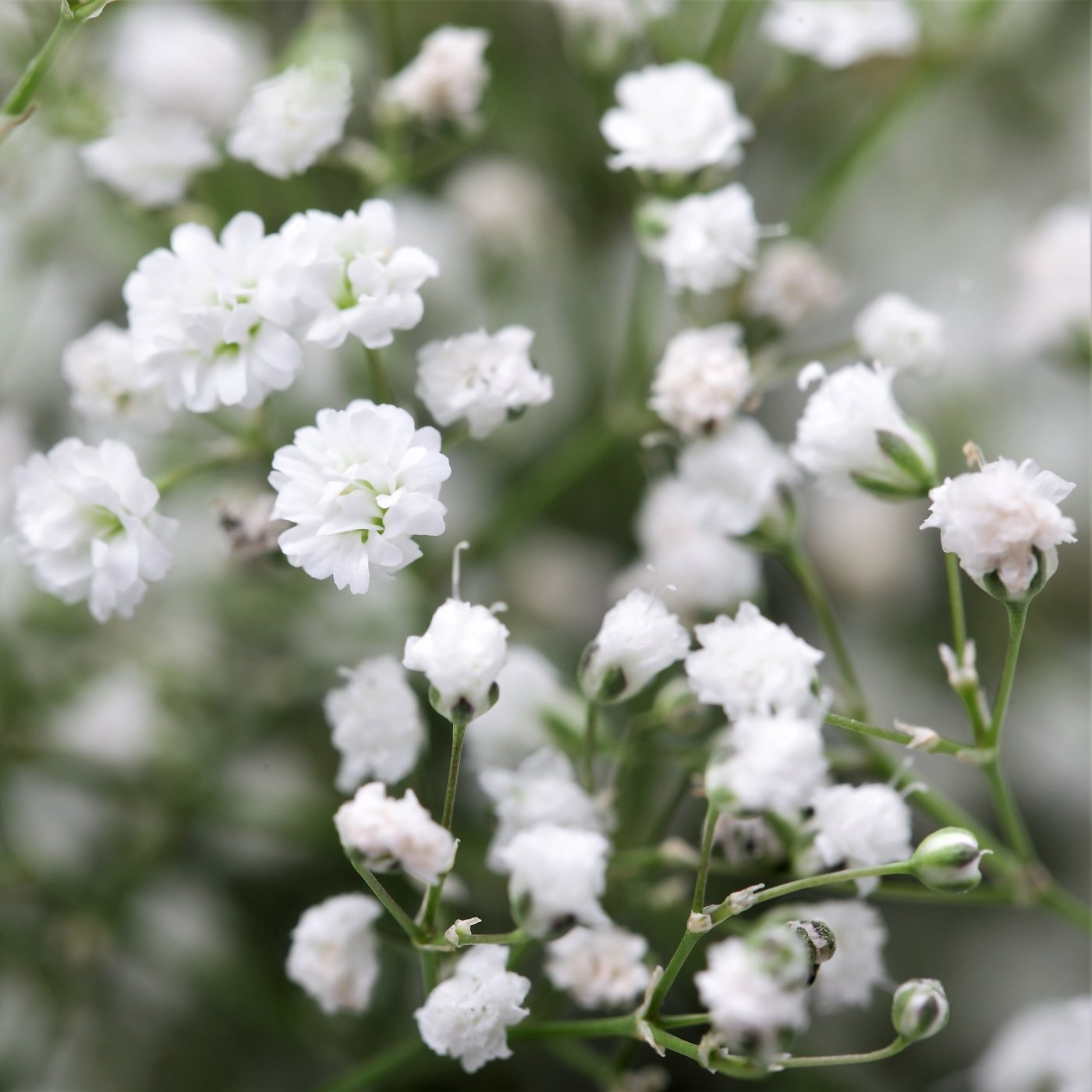
Crop details
Gypsophila (baby’s breath)
Categories
Quick stats
| Family | Caryophyllaceae |
|---|---|
| Typical harvest | 6.0 t/ha |
| Varieties | 3 |
| Pests & diseases | 9 |
| Seasons | 3 |
Crop profile
| Growth habit | perennial |
|---|---|
| Days to harvest | 365 |
| Main uses | Cut flower filler in bouquets and arrangements, dried flower and decorative use. |
| Pollination | insect |
| Origin / where it grows | Cool-season floriculture crop grown in highland/temperate areas, often under greenhouse or net-house conditions. |
Weather, soil & spacing
| Best temperature | 10–20 °C |
|---|---|
| Rainfall | 600–800 mm/yr |
| Altitude | 1200–2600 m |
| Best pH | 6.5–7.5 |
| Soil type | Well-drained, light to medium-textured loams or sandy loams; prefers “sweet” (near-neutral) soils and is sensitive to waterlogging. |
| Row spacing | 40 cm |
| Plant spacing | 20 cm |
| Planting depth | 2 cm |
| Seed rate | 0.5 kg/ha |
| Nursery days | 35 |
Simple notes for farmers
About the crop: This crop is perennial, which means once you plant it, the same plant can keep producing for many years. You can normally start harvesting about 365 days after planting, depending on care and variety.
Main use: Farmers mostly grow this crop for cut flower filler in bouquets and arrangements, dried flower and decorative use..
Pollination: This crop is mainly pollinated by insect. Keeping flowers healthy and having insects like bees in the field helps improve fruit set and yields.
Where it grows: Cool-season floriculture crop grown in highland/temperate areas, often under greenhouse or net-house conditions. It is grouped under: Oil & Industrial.
Best climate: This crop does well in warm areas where the temperature is usually between 10 and 20 degrees Celsius. It prefers places that receive around 600 to 800 millimetres of rain in a year. It can grow from near sea level up to about 2600 metres above sea level.
Soil: The crop grows best in slightly acidic to near neutral soils, with a pH of about 6.5 to 7.5. It does well in well-drained, light to medium-textured loams or sandy loams; prefers “sweet” (near-neutral) soils and is sensitive to waterlogging.. Good drainage is important, so avoid waterlogged spots.
Plant spacing: Plant in rows about 40 centimetres apart, and leave about 20 centimetres between plants in the row. This gives each plant enough space for roots and canopy to spread.
Planting depth: Dig planting holes or furrows about 2 centimetres deep so the roots sit firmly in the soil but are not buried too deep.
Seed or planting material: Use around 0.5 kilograms of seed or planting material per hectare. Spread or plant evenly so the field has a good stand without being overcrowded.
Nursery period: If you raise seedlings in a nursery, keep them there for about 35 days before transplanting to the main field, when they are strong and healthy.
Farmer guide (mwongozo wa mkulima)
Nutrient schedule (mbolea kwa hatua)
| # | Stage | DAP | Product | Rate | Targets (kg/ha) | Notes |
|---|---|---|---|---|---|---|
| 1 | Basal at planting | 0 | NPK 17-17-17 + compost | 160 kg/ha (plus 5–8 t/ha compost) | N: 27, P₂O₅: 27, K₂O: 27 | Broadcast and incorporate thoroughly into raised beds before transplanting seedlings or cuttings. |
| 2 | Early growth topdress | 30 | CAN 26% N | 90 kg/ha | N: 23, P₂O₅: 0, K₂O: 0 | Apply along rows on moist soil or via fertigation in smaller, frequent doses. |
| 3 | Flowering K boost | 70 | Sulfate of potash (SOP) | 80 kg/ha | N: 0, P₂O₅: 0, K₂O: 40 | Apply during main flowering periods to strengthen stems and improve spray quality; use SOP to avoid chloride stress. |
Nutrient requirements
| Nutrient | Stage | Amount | Unit |
|---|---|---|---|
| N | Basal | 40 | kg/ha |
| P₂O₅ | Basal | 40 | kg/ha |
| K₂O | Basal | 60 | kg/ha |
| N | Early_growth | 40 | kg/ha |
| P₂O₅ | Early_growth | 10 | kg/ha |
| K₂O | Early_growth | 40 | kg/ha |
| N | Production_flush | 30 | kg/ha |
| P₂O₅ | Production_flush | 0 | kg/ha |
| K₂O | Production_flush | 50 | kg/ha |
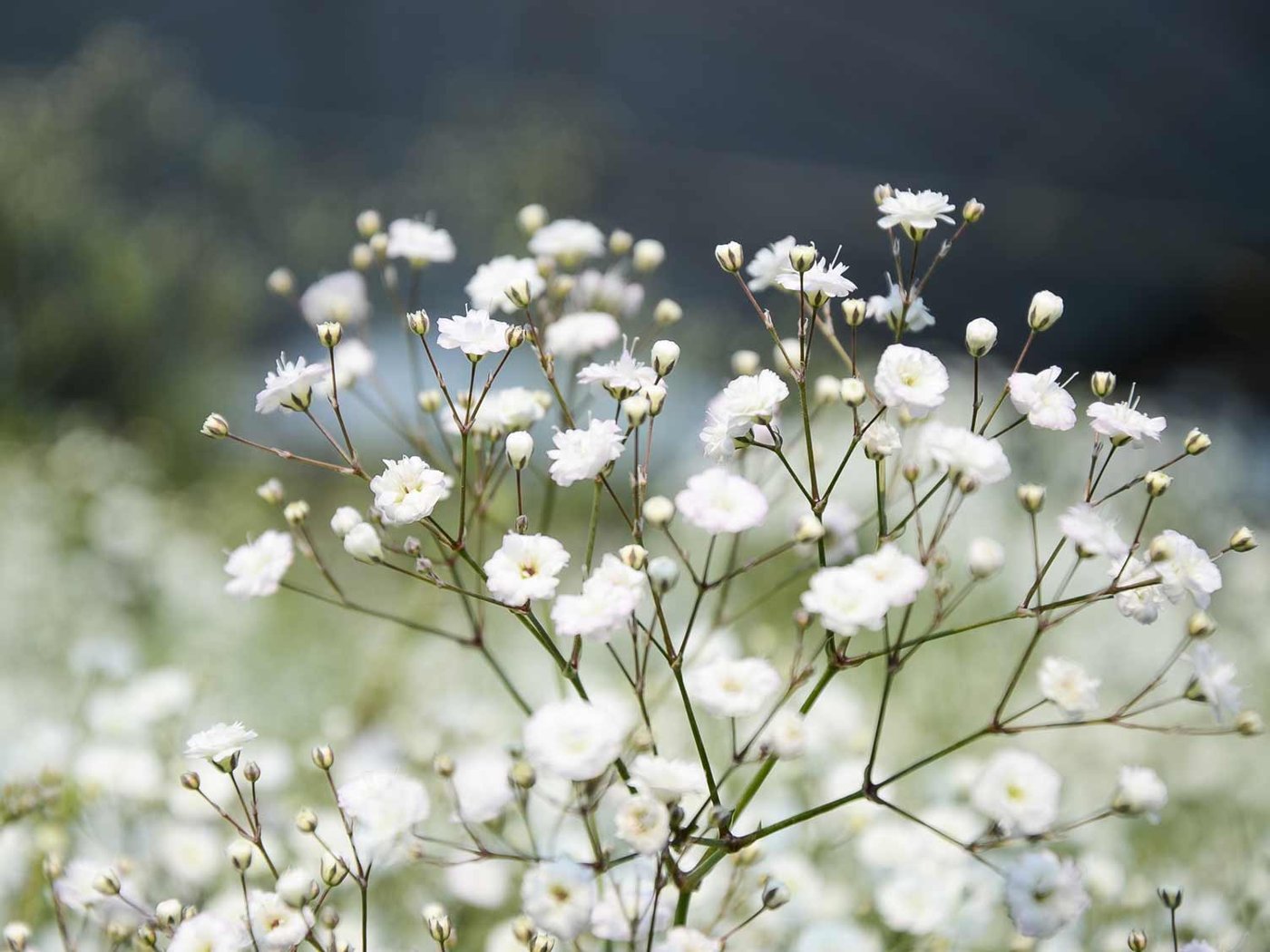
Field images (picha shambani)

| Name | Country | Maturity | Traits |
|---|---|---|---|
| White gypsophila selection | KE | 365 | Fine, dense sprays of white florets suitable for export bouquets and fillers. |
| Tintable gypsophila type | TZ | 365 | Good structure for tinting/dyeing for coloured arrangements and bouquet work. |
| Local gypsophila/flower filler type | UG | 365 | Adapted to local highland conditions, used by florists as filler and dried flowers. |
| Stage | Product | Rate (kg/ha) | Notes |
|---|---|---|---|
| Basal | NPK 17-17-17 + compost | 160 | Apply and incorporate into raised beds prior to planting to provide base fertility and organic matter. |
| Vegetative/branching | CAN 26% N | 90 | Apply 3–5 weeks after planting or deliver via fertigation to support branching and canopy build. |
| Flowering quality | Sulfate of potash (SOP) | 80 | Apply during key flowering phases to enhance stem strength and floret quality while avoiding chloride buildup. |
| Name | Type | Symptoms | Management |
|---|---|---|---|
| Aphids | pest | Clusters on soft shoots and flower stems, honeydew and sooty mould, distorted growth. | Maintain weed control, use biological control agents where possible and apply selective measures only when thresholds ar... |
| Thrips | pest | Scarring and flecking on small florets, brown tips and reduced decorative quality. | Use sticky traps, maintain hygiene, net or screen vents, and implement IPM controls focusing on buds and flowers. |
| Spider mites | pest | Fine webbing on undersides of leaves, speckling and bronzing, dried foliage in heavy infestations. | Avoid severe water stress, maintain good humidity balance and introduce predatory mites where feasible. |
| Leaf miners | pest | Serpentine mines in leaves, cosmetic damage and reduced photosynthesis. | Remove infested leaves, keep weeds low, and use traps and targeted IPM tools as needed. |
| Cutworms and small caterpillars | pest | Chewed stems and leaves near the base, cut seedlings, occasional bud damage. | Good field sanitation, weed control and early intervention when damage is first observed. |
| Crown and root rots | disease | Stunted plants, yellowing, wilting, rotten crown/root tissues especially in poorly drained spots. | Ensure excellent drainage, avoid over-irrigation, raise beds and rotate away from problem sites. |
| Botrytis (grey mould) | disease | Grey mould on stems, florets and foliage in cool, humid conditions; postharvest decay. | Avoid overhead wetting, improve ventilation, harvest dry stems and maintain cleanliness in production and pack house. |
| Fusarium / vascular wilts | disease | One-sided wilting, yellowing and brown vascular tissue in stems and roots. | Use clean planting material, avoid reusing contaminated beds and rotate crops in affected blocks. |
| Nutrient/physiological disorders | disorder | Weak, lodging stems, pale foliage or chlorosis between veins, small or uneven sprays. | Balance fertilization (especially Ca, Mg, Fe and B), avoid excessive N and maintain appropriate EC and pH in irrigation... |
| System | Typical | Min | Max | Notes |
|---|---|---|---|---|
| Open-field / low-input gypsophila | 3 | 2 | 4 | Represents modest stem biomass; in practice, growers often track stems/ha (~150–250k stems). |
| Greenhouse / net-house managed | 6 | 4 | 8 | Good fertigation, support and pest management; 250–400k stems/ha/year depending on system. |
| Intensive export floriculture | 9 | 6 | 12 | High plant density, precise fertigation and year-round production with strong quality grading. |
| Country | Region | Planting | Harvest |
|---|---|---|---|
| KE | High-altitude floriculture belts | New beds can be established much of the year where irrigation is available; cooler months favoured for establishment. | First marketable stems usually 4–6 months after planting, with successive flushes and near year-round production under protected systems. |
| TZ | Northern and southern highlands suited to floriculture | Plant when temperatures are moderate and irrigation is assured, commonly in cooler seasons. | Continuous harvest once stands are in production, with best quality in cool, bright periods. |
| UG | Highland and cooler mid-altitude areas with floriculture potential | Plant at onset of reliable rains for open systems or any time under irrigation and mild temperatures. | Regular cutting of stems once plants reach production, with peaks in cooler, drier seasons. |
| Country | Region | Suitability |
|---|---|---|
| KE | Highland floriculture zones with cool nights and good irrigation infrastructure | High |
| TZ | Northern/southern highlands and irrigated mid-altitude valleys suited to cool floriculture crops | High |
| UG | Highland and cooler mid-altitude zones with reliable water supply and good drainage | High |