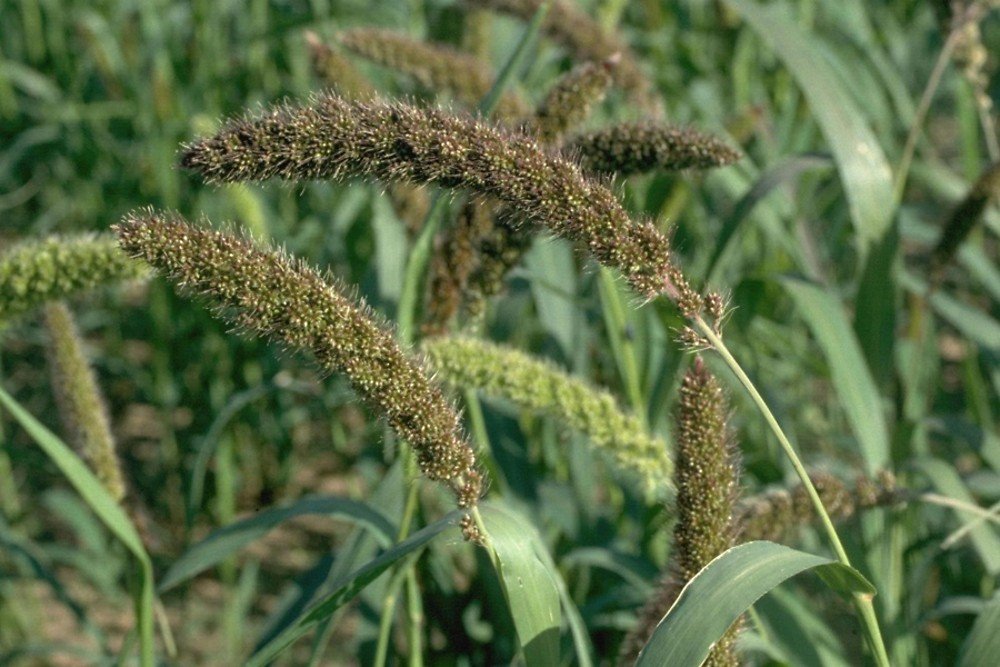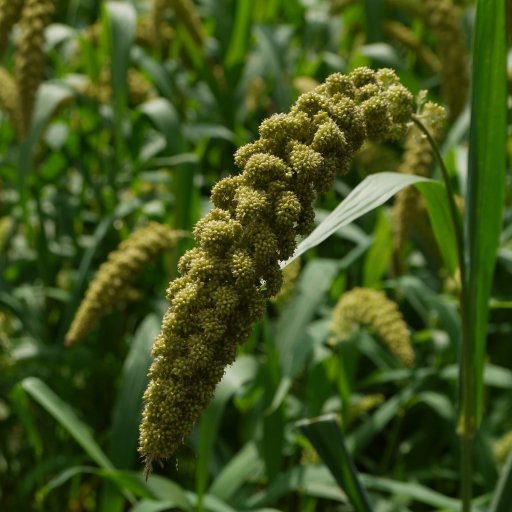
Quick stats
| Family | Poaceae |
|---|---|
| Typical harvest | 5.3 t/ha |
| Varieties | 7 |
| Pests & diseases | 16 |
| Seasons | 8 |
Crop profile
| Growth habit | annual |
|---|---|
| Days to harvest | 80-110 |
| Main uses | Cereal grain |
| Pollination | wind |
| Origin / where it grows | Asia; grown in drylands |
Weather, soil & spacing
| Best temperature | 22–32 °C |
|---|---|
| Rainfall | 350–600 mm/yr |
| Altitude | 0–2200 m |
| Best pH | 5.5–7 |
| Soil type | Light to medium soils |
| Row spacing | 45 cm |
| Plant spacing | 15 cm |
| Planting depth | 2 cm |
| Seed rate | 8 kg/ha |
| Nursery days | — |
Simple notes for farmers
About the crop: This crop is annual. You plant, grow and harvest it in one main season, then plant again. You can normally start harvesting about 80-110 days after planting, depending on care and variety.
Main use: Farmers mostly grow this crop for cereal grain.
Pollination: This crop is mainly pollinated by wind. Keeping flowers healthy and having insects like bees in the field helps improve fruit set and yields.
Where it grows: Asia; grown in drylands It is grouped under: Cereals & Pseudocereals.
Best climate: This crop does well in warm areas where the temperature is usually between 22 and 32 degrees Celsius. It prefers places that receive around 350 to 600 millimetres of rain in a year. It can grow from near sea level up to about 2200 metres above sea level.
Soil: The crop grows best in slightly acidic to near neutral soils, with a pH of about 5.5 to 7. It does well in light to medium soils. Good drainage is important, so avoid waterlogged spots.
Plant spacing: Plant in rows about 45 centimetres apart, and leave about 15 centimetres between plants in the row. This gives each plant enough space for roots and canopy to spread.
Planting depth: Dig planting holes or furrows about 2 centimetres deep so the roots sit firmly in the soil but are not buried too deep.
Seed or planting material: Use around 8 kilograms of seed or planting material per hectare. Spread or plant evenly so the field has a good stand without being overcrowded.
Farmer guide (mwongozo wa mkulima)
Nutrient schedule (mbolea kwa hatua)
| # | Stage | DAP | Product | Rate | Targets (kg/ha) | Notes |
|---|---|---|---|---|---|---|
| 1 | Basal | 0 | NPK 17-17-17 | 80 kg/ha | N: 18, P₂O₅: 40, K₂O: — | Band 5 cm beside and 5 cm below seed; avoid direct contact with seed. |
| 2 | Topdress | 30 | Urea | 40 kg/ha | N: 21, P₂O₅: —, K₂O: — | Apply when plants are 4–6 leaves; side-dress and cover lightly. |
| 3 | Late topdress | 35 | Urea 46% N | 70 kg/ha | N: 32, P₂O₅: —, K₂O: — | Apply before tasseling; avoid application on very dry soil. |
| 4 | K and secondary nutrients | 30 | NPK or MOP (KCl) as per soil test | 40 kg/ha K2O equiv. | N: —, P₂O₅: —, K₂O: 40 | Adjust based on soil test; avoid chloride-sensitive rotations where needed. |
| 5 | Micronutrient correction | 25 | Zn / B foliar mix | 0 — | N: —, P₂O₅: —, K₂O: — | Apply as foliar spray under cool conditions where deficiencies confirmed. |
Nutrient requirements
| Nutrient | Stage | Amount | Unit |
|---|---|---|---|
| N | Basal | 30 | kg/ha |
| P₂O₅ | Basal | 20 | kg/ha |
| K₂O | Basal | 20 | kg/ha |
| N | Topdress | 20 | kg/ha |
| N | Early_growth | 40 | kg/ha |
| K₂O | Early_growth | 20 | kg/ha |
| N | Pre_tassel | 50 | kg/ha |
| K₂O | Pre_tassel | 20 | kg/ha |
| N | Topdress_early | 40 | kg/ha |
| P₂O₅ | Topdress_early | 0 | kg/ha |
| K₂O | Topdress_early | 20 | kg/ha |
| N | Topdress_late | 30 | kg/ha |
| P₂O₅ | Topdress_late | 0 | kg/ha |
| K₂O | Topdress_late | 20 | kg/ha |
Field images (picha shambani)
| Name | Country | Maturity | Traits |
|---|---|---|---|
| Local Foxtail | KE | 95 | Drought tolerant |
| H614D | KE | 150 | High-yielding hybrid for high potential zones; good standability. |
| SC Duma 43 | KE | 95 | Early; short rains |
| DK 8031 | KE | 115 | Medium maturity hybrid |
| KH 500-21A | KE | 110 | OPV; stable performance |
| Katumani composite | KE | 90 | Early-maturing OPV; suited to low-rainfall and short-season areas. |
| Local white maize | KE | 120 | Traditional variety; preferred taste but lower and less stable yields. |
| Stage | Product | Rate (kg/ha) | Notes |
|---|---|---|---|
| Basal | NPK 17-17-17 | 80 | |
| Topdress | Urea 46% N | 40 | |
| Basal | DAP 18-46-0 | 100 | Adjust rate to soil P; can be substituted with other P sources. |
| Topdress 1 | CAN 26% N | 150 | V3–V4 |
| Topdress 2 | Urea 46% N | 100 | Pre-tassel |
| Supplement | MOP (KCl, 60% K2O) | 60 | Apply where K is low |
| Soil health | Well-decomposed manure | 2000 | Pre-plant incorporation |
| Topdress (early) | CAN 26% N | 80 | Less volatilization risk than urea; good on acidic soils. |
| Topdress (late) | Urea 46% N | 70 | Incorporate where possible; avoid application on very hot dry days. |
| K supplement | Muriate of potash (MOP) | 60 | Apply where K is deficient; avoid overuse on saline-sensitive systems. |
| Name | Type | Symptoms | Management |
|---|---|---|---|
| Bird damage | pest | Panicle feeding | Scaring; netting near harvest |
| Fall armyworm (Spodoptera frugiperda) | pest | Whorl feeding, window-paned leaves, frass in whorl, dead hearts in severe cases | Early scouting; conserve natural enemies; use pheromone traps, biopesticides and selective insecticides where thresholds... |
| African maize stalk borer (Busseola fusca) | pest | Shot-holes in young leaves; dead-heart; tunneling | Timely planting; destroy residues; selective insecticides if threshold exceeded |
| Maize weevil (Sitophilus zeamais) | pest | Storage grain damage; weight loss | Dry to ≤13% moisture; hermetic bags; clean stores |
| Striga (Striga hermonthica) | weed | Stunted plants; purple parasitic flowers near base | Push-pull (Desmodium + Napier/Brachiaria); rotation; resistant/tolerant varieties |
| Gray leaf spot | disease | Rectangular lesions between veins; leaf blight and yield loss in humid areas | Resistant hybrids, rotation, residue management, and fungicide where high risk. |
| Northern leaf blight | disease | Long, cigar-shaped grayish lesions on leaves; premature drying | Use resistant varieties; practice crop rotation and residue management; apply fungicides where economic. |
| Maize lethal necrosis (MLN) | disease | Severe mosaic, chlorosis, plant death | Use MLN-tolerant seed where available; control vectors; hygiene |
| Fall armyworm | pest | Whorl damage; frass | Early scouting; Bt/biocontrol; rotate actives |
| Maize stalk borer | pest | Shot-holes; dead-heart | Timely planting; destroy residues |
| Maize weevil | pest | Storage grain loss | Dry to ≤13%; hermetic bags |
| Striga | weed | Stunting; purple flowers | Push–pull; rotation; tolerant varieties |
| MLN | disease | Severe mosaic/chlorosis | MLN-tolerant seed; hygiene; vector control |
| Maize stem borers | pest | Shot holes, frass at leaf axils, tunneling in stems, lodging and reduced ears | Plant on time; destroy crop residues; use push–pull systems and resistant varieties. |
| Cutworms | pest | Cut seedlings at or near ground level, missing plants in rows | Prepare fine seedbeds; avoid excessive weeds; targeted spot treatments when damage is localized. |
| Maize streak virus | disease | Fine yellow streaks on leaves, stunting, poor ear formation | Use tolerant varieties; control vector leafhoppers; avoid very late planting and volunteer maize. |
| System | Typical | Min | Max | Notes |
|---|---|---|---|---|
| rainfed smallholder | 1.5 | 0.8 | 2.5 | |
| smallholder rainfed | 2 | 0.8 | 4.5 | Depends on rain, fertility, FAW control |
| improved rainfed hybrid | 5 | 3 | 8 | Good seed, spacing, weed and FAW control |
| irrigated high-input | 9 | 6 | 12 | Fertigation and tight crop protection |
| improved rainfed | 5 | 3 | 8 | Good hybrid, spacing, weeding, N splits |
| irrigated/high-input | 9 | 6 | 12 | Tight water & nutrients |
| smallholder rainfed (low input) | 2.5 | 1 | 4 | Local seed, minimal fertilizer and weed control |
| smallholder rainfed (improved) | 5 | 3 | 7 | Hybrid seed, recommended NPK and timely weeding |
| irrigated/high input | 9 | 7 | 12 | Good hybrids, irrigation and precision nutrient management |
| Country | Region | Planting | Harvest |
|---|---|---|---|
| KE | Drylands | Mar–Apr | Jun–Aug |
| KE | High/medium potential (long rains) | Mar–Apr | Jul–Sep |
| KE | High/medium potential (short rains) | Oct–Nov | Feb–Mar |
| UG | Central & Western | Mar–Apr / Aug–Sep | Jul–Aug / Dec–Jan |
| TZ | Northern & Southern Highlands | Nov–Dec / Mar | Apr–Jun / Aug–Sep |
| KE | High potential maize zone (long rains) | Mar–Apr | Aug–Sep |
| KE | Medium altitude (short rains) | Oct–Nov | Feb–Mar |
| TZ | Southern highlands | Nov–Dec | May–Jun |
| Country | Region | Suitability |
|---|---|---|
| KE | >2500 m (frost risk) | Low |
| KE | Arid zones (low rainfall) | Low |
| KE | Arid zones with poor rainfall | Low |
| KE | Central Highlands | High |
| KE | Central highlands (Murang’a, Nyeri) | High |
| KE | Coastal hinterland | Moderate |
| KE | Coastal hinterland (Kilifi, Kwale) | Moderate |
| KE | Drylands | High |
| KE | Eastern lower mid-altitudes (Makueni, Kitui) | Moderate |
| KE | High potential maize zone (Rift Valley) | High |
| KE | Lower Eastern (Makueni, Kitui) | Moderate |
| KE | Medium altitude transitional zones | High |
| KE | Rift Valley (Uasin Gishu, Trans Nzoia) | High |
| KE | Semi-arid lowlands | Medium |
| KE | Very high altitude >2500 m (frost risk) | Low |
| KE | Western & Nyanza | High |
| TZ | Southern Highlands & Lake Zone | High |
| TZ | Southern highlands maize belt | High |
| UG | Eastern & Central | High |
| UG | Lake Victoria crescent | High |